Atelier Lumen

Light installation studio · Antwerp · est. 2016

Darkness is not an absence. It is the material.

Darkness is not an absence. It is the material.

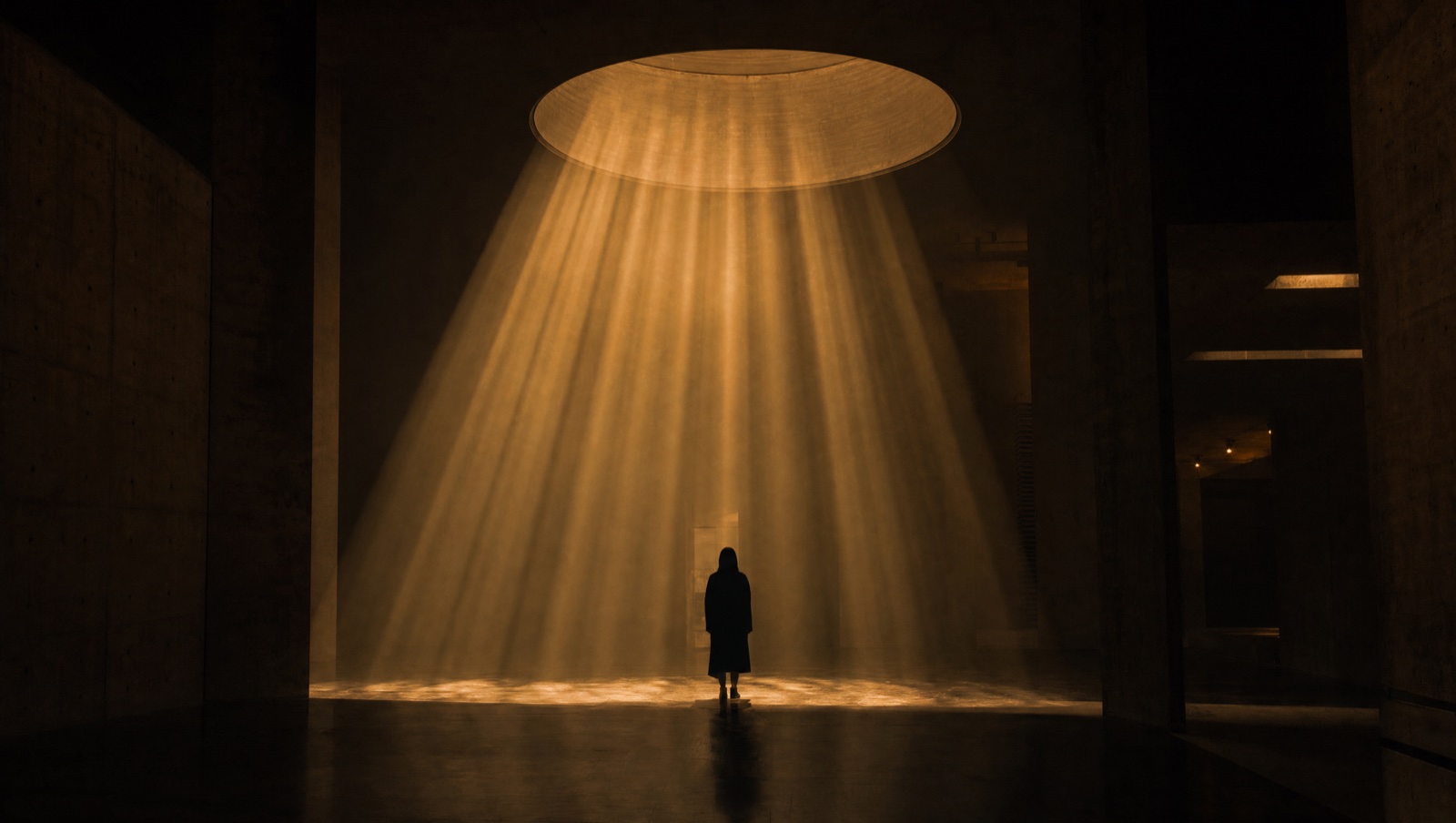
A lone visitor stands inside a cone of amber volumetric light in a dark concrete hall.
field study · overhead aperture · haze held at 0.4 g/m³

We build rooms out of what the eye can barely hold: four lux, a single sodium line, a sunset stretched to six hours. Since 2016, five permanent works and twenty-three commissions have been carved from the dark.

Your cursor is a light source. Carry it.
descend

Portfolio, 2022 — 2025

Five works
in darkness

Each installation is listed with its photometric spec — the studio publishes output, colour temperature and field for every work, the way a printmaker states edition and paper.

  1. Vespers

    Kraftwerk Mitte, Berlin · 2025 · permanent

    Two hundred forty bare tungsten filaments hang on black wire in the thirty-metre nave of a decommissioned power station. They dim and swell in a forty-one-minute cycle transcribed from a 1962 recording of evensong at Magdeburg Cathedral — each lamp a voice, each blackout a held breath. Visitors report the room feels warmer at full song. It is not; the change is one of colour, not heat.

    Medium
    240 filament lamps, DMX-dimmed
    Colour
    1,900 K at full song
    Field
    30 × 9 × 14 m nave
    Ambient
    4 lux, floor level
    Cycle
    41 min, continuous
    fig. 01 — suspension plan, nave section
  2. Threshold

    Kapel Sint-Agnes, Ghent · 2024 · permanent

    A single doorway in a fourteenth-century chapel is lit by low-pressure sodium — the purest monochrome light industry ever made, one wavelength, 589 nanometres. Cross it and every colour you carry is confiscated: skin, cloth and stone render in absolute amber. Two steps beyond, the world is returned. The work is about what you agree to give up in order to enter.

    Medium
    2 × 90 W low-pressure sodium
    Colour
    589 nm, monochromatic
    Portal
    2.4 × 1.1 m passage
    Ambient
    12 lux inside the frame
    Cycle
    static · dusk to midnight
    fig. 02 — sodium portal, elevation
  3. Low Sun

    Turbinehal Vest, Copenhagen · 2024 · seasonal, Nov — Feb

    A seven-metre semicircular emitter sits directly on the turbine-hall floor, held at the exact altitude and colour of the Copenhagen sun at 15:41 on the winter solstice — then never allowed to set. Fine haze keeps the beam visible as a solid object. Commissioned as a civic response to the Danish November; forty thousand people sat with it in its first season.

    Medium
    7 m LED arc, 0.4 g/m³ haze
    Colour
    3,200 K, CRI 96
    Field
    44 × 26 m hall
    Output
    96,000 lm, floor bounce
    Cycle
    static · a sunset withheld
    fig. 03 — arrested sun, haze isolines
  4. Meridian Noise

    Benesse Annex, Naoshima · 2023 · permanent

    The studio's only cold work. A half-degree blade of 6,500 K white crosses the dark gallery exactly once per hour, accurate to the second — a clock with one hand made of light. Where the blade meets the wall it picks up a strip of graphite text, sixty entries, one legible per minute. Most visitors stay for three or four minutes. Some stay the hour. The guestbook divides sharply between the two.

    Medium
    1 moving profile, 0.5° beam
    Colour
    6,500 K — cold, sparingly
    Field
    18 × 18 m gallery
    Traverse
    60 min 00 s per pass
    Cycle
    hourly · synced to JST
    fig. 04 — one-hand clock, plan view
  5. The Long Dusk

    One-room house, Presidio County, Texas · 2022 · permanent

    An adobe room forty minutes outside Marfa where sunset lasts six hours. Fourteen thousand addressable channels line the west wall, replaying the actual sky — sampled live from the roof — at one-twelfth speed. You watch this evening's dusk happen slowly enough to see it move. Booked by the night; one guest, or two. The visitors' log runs to nine volumes and is mostly apologies for what people wrote.

    Medium
    14,000 ch LED field, live sky feed
    Colour
    1,800 — 3,400 K drift
    Field
    one room, 6 × 4 m
    Tempo
    real sky at 1/12 speed
    Cycle
    6 h · nightly · one party
    fig. 05 — dusk gradient, west elevation

Method

How a room
learns to be dark

Every commission moves through the same three rooms. Two of them have no lights in them at all.

I

Sit in the dark

We begin every project by switching everything off and staying for two hours — the time a human eye needs to reach full dark adaptation. We measure the darkness we were given: stray light through service doors, the green breath of exit signage, the sodium wash of the street outside. You cannot add light honestly until you know what dark you actually have. Most sites, it turns out, have none.

Site survey deliverable: a darkness report, typically 30–60 stray sources, each mapped and negotiated away.

II

Write the score

Light over time is notated like music: lux on the vertical, minutes on the horizontal, dynamics marked from niente to a forte of perhaps twelve lux. The score below is the second movement of Vespers — the ninety-second blackout at minute 26 is the moment the guestbook mentions most. We keep a plotter in the studio for printing scores at 1:1; clients sign the score, not a render.

House rule: nothing in a Lumen work exceeds 12 lux at eye height. Above that, you are lighting; below it, you are composing.

III

Build at night

Full-scale mockups are tuned between midnight and four, on site, by eye. Meters are trusted down to ten lux; beneath that they flatter, so the last octave is set by two people agreeing in the dark. Focus calls are silent. The record is Meridian Noise: nineteen nights for one moving beam, eleven of them spent on the sound the motor was not allowed to make.

Commissioning ends with the handover walk: the client carries a single candle through the finished work. If the candle improves it, we start again.

Photometric score: a stepped amber intensity curve over 41 minutes, peaking at 12 lux, with a 90 second blackout at minute 26. 12 8 4 0 lux 0′ 10′ 20′ 30′ 41′ pp poco a poco mf niente — 90″ f, 12 lux morendo VESPERS — movement II · photometric score, plotter print 1:1 · signed M.O. / I.B., March 2025

The atelier

A tram depot,
kept dim on purpose

Atelier Lumen was founded in 2016 by Mara Ostrowski, a lighting engineer who spent nine years running followspots at Opera Vlaanderen, and Ilyas Benali, an architect who kept designing buildings with fewer and fewer windows until a practice for darkness became inevitable. The studio occupies a decommissioned tram depot in Antwerp-Borgerhout, chosen for its forty-metre hall and its total absence of daylight.

Seven people work here — two engineers, a haze specialist, a horologist, a writer, and the founders. The hall is kept at four lux, house-standard 1,900 K, so that every mockup is judged in the conditions it will live in. Lunch is the one bright hour.

“We do not install lights.
We ration them.”

— M. Ostrowski, acceptance speech, Prix Lumière Nordique 2024
Permanent works
5
Commissions since 2016
23
Countries
11
House colour
1,900 K
Brightest work to date
12 lux
Hall darkness, measured
0.03 lux

Commissions

Bring us
your darkness

The studio accepts two commissions a year — museums, sacred spaces, civic halls, and the occasional private room. Write to us with the darkness you have, or the darkness you want. Renders are never supplied; scores are.

commissions@atelierlumen.be

Kopstraat 11, 2140 Antwerp-Borgerhout, Belgium
Visits after dusk, by appointment. Replies within the week — sooner in winter.

Next window
Q2 2027 — two commissions
Applications open
1 November 2026
Format
one letter, one plan, no renders
Site visits
new-moon weeks only