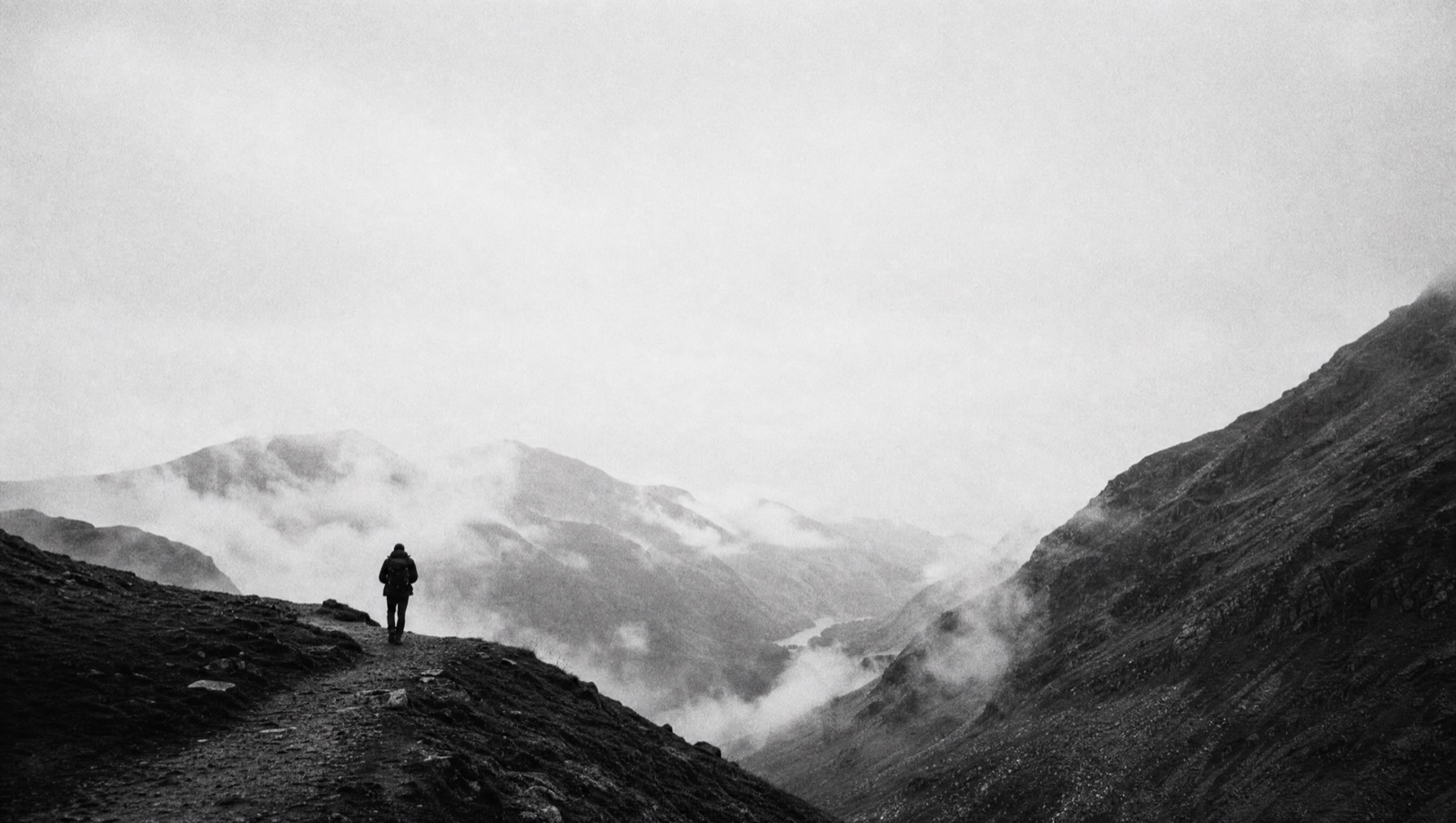
Before any craft begins, somebody has to arrive without hurrying. Our autumn issue opens on a valley path where fog, weather and distance set the tempo before a hand touches flour, dye or type.
Plate 0A A fog valley generated for this issue and printed here as the opening pause: one figure, no deadline, the weather still deciding what can be seen.
01
Feature I · Ferment · Thomaston, Maine
The Hundred-Year Starter
At Ovenbird Bakery on the Maine coast, Sigrid Aldercott keeps a rye culture that has outlived four ovens, two wars and every hand that ever fed it before hers. She would like you to stop calling it an heirloom. It is, she says, a colleague.
Words · Imogen VanceIllustration · Otto Reisz
Fig. 1 — Thursday’s boule, scored with the four-leaf lame pattern Aldercott’s great-grandmother used on Gotland. Rye, salt, water, ninety-four years.
The starter wakes before Sigrid Aldercott does. By half past four the crock on the counter of Ovenbird Bakery has already risen an inch under its linen cloth, breathing its sour, orchard-floor breath into the dark, and by the time Aldercott comes downstairs at five she speaks to it before she speaks to anyone else. What she says varies. That she says something does not.
The culture was begun in 1932 by her great-grandmother, Marta Lindqvist, in a fishing town on the Swedish island of Gotland, from nothing but stone-milled rye1 and rainwater. It crossed the Atlantic in 1951 inside a lidded tobacco tin, declared at customs — truthfully, if not helpfully — as porridge. Four generations have fed it since, twice a day, without one recorded lapse. The bakery’s ledger of feedings, a habit Marta started and nobody dared stop, now runs to thirty-one volumes.
What ninety-four years buys you, it turns out, is not mystique but stability. The Ovenbird culture is so settled in its ways that Aldercott can predict its peak to within ten minutes, season by season, the way you might predict an old friend’s arrival by the sound of their particular car. Microbiologists from Orono who sampled it in 2019 found a population2 almost indecently serene: a few resident strains, deeply entrenched, entirely uninterested in newcomers.
You cannot rush a thing whose entire job is to take its time.
Sigrid Aldercott
The bread itself proves for twenty-six hours in a granite-walled cellar that holds eleven degrees the year round. Aldercott bakes forty loaves a day, five days a week, and not one more. Wholesalers call every spring with spreadsheets showing what she could do with a second oven, a night shift, a franchise in Portland. She listens politely, offers them coffee and the heel of yesterday’s loaf, and explains that the starter sets the schedule, and the starter has never once read a spreadsheet.
“People say I’m keeping it alive,” she says, folding the morning’s dough with hands that know the work better than her eyes do. “That’s backwards. It kept my family fed through a war and a crossing and three recessions. I’m staff.” She taps the crock’s shoulder like a cab driver patting the dashboard. Somewhere in there, 1932 is still quietly rising.
✽
Et cetera · the issue, by the numbers
The Slow Index
Years the rye culture at Ovenbird Bakery has been continuously fed
94
Hours a single boule spends proving in Aldercott’s cellar
26
Days Haruko Nishimura’s sukumo ferments before she will call it a vat
100
Dips required to reach the shade Tokushima dyers call kachi-iro
48
Picas of finished verse Wendell Marsh sets in an hour, on a good morning
6
Copies in every edition from the Patience Press, no exceptions
90
Seconds the average reader now grants a magazine page, per one industry study
27
Minutes this page was designed to take
11
Interviews for this issue conducted entirely by post, in percent
40
Deadlines missed, gracefully, in the making of Issue Nº 09
14
Sources: the Ovenbird feeding ledger, vols. i–xxxi; the BUAISOU dye registry; the Patience Press day-book; our own shameful correspondence.
02
Feature II · Dye · Tokushima, Japan
Waiting for Indigo
A proper aizome vat is not mixed; it is persuaded. In the Yoshino river valley, fourth-generation dyer Haruko Nishimura spends a hundred days composting leaves before the first thread touches liquid — and then the real waiting begins.
Words · Theo MarchettiIllustration · Ayaka Ono
Nothing about the vat looks alive at first. A waist-high ceramic cylinder sunk to its shoulders in the workshop floor, dark liquid lying flat as a shut eye, a faint smell somewhere between silage and sea air. Then Haruko Nishimura draws off the ladle and points to the surface, where a ring of bronze-purple bubbles has gathered like froth on a cauldron of night. “Ai no hana,” she says. The indigo flower.3 “When the flower stands, the vat is willing. You do not ask before that.”
Willingness takes time to manufacture. Every summer Nishimura’s family cuts Persicaria leaves from fields their neighbours have farmed since the Meiji era, dries them, then heaps them into a mountain called a toko that is watered, turned and argued with for one hundred days until it collapses into sukumo4 — a black, peaty compost that holds the blue the way coal holds fire. Mixed with lye, wheat bran and a little sake, the sukumo wakes over another week or two. There is no thermostat. There is a wooden lid, a quilt, and Nishimura’s palm laid flat against the ceramic every morning, reading the vat’s temperature the way you would a child’s forehead.
Fig. 2 — The number-three vat, mid-persuasion. The froth at centre is the ai no hana; the seal is the workshop’s mark, cut in 1923.
The dyeing itself, when it finally comes, is almost anticlimactically brief: a minute’s submersion, a squeeze, and the cloth emerges not blue but a livid yellow-green that turns before your eyes as the air gets at it — teal, then petrol, then a blue with the door shut behind it. One dip gives you a whisper. Nishimura’s deepest commissions take forty-eight, spread over two weeks because the vat, like any organism doing heavy work, must be allowed to rest and eat between shifts.
The vat does not care that you are in a hurry. The vat has been asleep for a hundred days.
Haruko Nishimura
Her order book currently stands at fourteen months. She reads out the waiting list the way other people read horoscopes — a theatre curtain in Kyoto, a christening blanket in Copenhagen, bolt after bolt for a tailor in Marseille who writes, every year, no rush. “That one understands,” she says, hanging the day’s last skein up into the wind, where the blue goes on quietly deepening without her. “The colour is not made in the vat. It is made in the air, afterwards. Everything good happens afterwards.”
✽
03
Feature III · Print · Clun, Shropshire
Six Picas an Hour
In a stone barn at the end of a Shropshire lane, Wendell Marsh sets poetry by hand in 14-point Caslon on an 1846 Albion press he calls Patience. His editions run to ninety copies and his errors run to zero, because in metal, every mistake is a decision.
Words · Nell AshworthIllustration · Otto Reisz
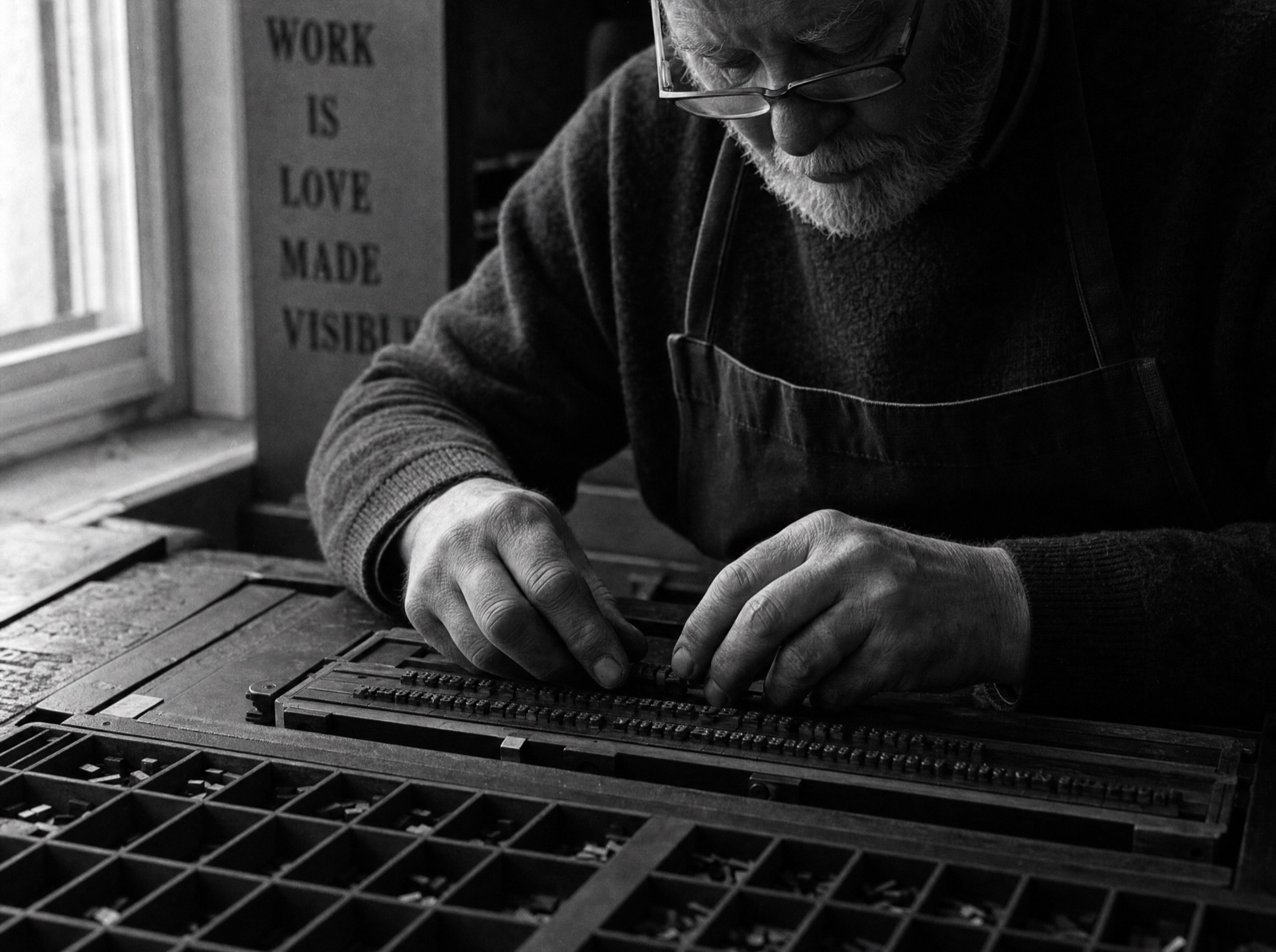
Plate 3B The hand before the machine: a generated letterpress study folded into the article as a full-spread proof, with the red plate held deliberately a hair out of register.
A pica is a sliver of distance — a sixth of an inch, twelve points, roughly the width of two letters and a breath. On a good morning, with strong tea and no visitors, Wendell Marsh sets six of them an hour. This is not a rate that survives contact with economics, which is why Marsh, sixty-one, a compositor for forty of those years, long ago stopped inviting economics into the barn.
The barn belongs to Patience, an Albion hand-press cast in London in 1846, all black iron and brass crown, acquired at a Shrewsbury farm auction in 1989 “for less than the trailer to move her cost.” Around her stand oak cabinets of type — Caslon, mostly,5 with some Baskerville kept, he says, for arguments. Every letter of every poem passes through Marsh’s right hand mirror-first: plucked from the case, dropped nick-up into the composing stick,6 read upside down and backwards with a fluency that has long since stopped feeling like a trick.
Fig. 3 — A 14-point sort, letter reversed as the compositor meets it. Read backwards, print forwards; mind your p’s and q’s.
Watching him work recalibrates your sense of what writing costs. A fourteen-line sonnet is an afternoon. A collection is a year, sometimes two, the poet driving out from Ludlow every few months to read proofs pulled damp from the press, the smell of ink and lanolin in everything. Marsh corrects nothing silently: each change is negotiated, because each change means opening the forme, easing out a line held under tension like a tiny masonry arch, and rebuilding it letter by letter. Poets, he notes, revise differently once they have watched that happen.
Every mistake I make, I make in metal. It teaches you to mean what you say.
Wendell Marsh
Ninety copies, always. Number one goes to the poet, number ninety to the barn’s rafters, where four decades of editions age in brown paper like wine. The other eighty-eight sell out by post within the month, to a list of subscribers Marsh has never advertised to and could not fully explain. “People think they’re buying a book,” he says, cleaning Patience’s platen at the day’s end, six new picas of a January poem locked up and waiting for morning. “They’re buying the hours. The book is just where the hours ended up.”
✽
Issue Nº 09 · set, proofed & put to bed
Colophon
Type
Headlines are set in Gloock; text in Spectral and its italic at a 62-character measure, ragged right, hyphenated by hand where the machine lost its nerve; folios, kickers and marginalia in Zilla Slab. Drop capitals stand four lines. Side-notes hang in the outer margin, where notes belong.
Paper & ink
The print edition is offset on Heritage Bone 118gsm, an uncoated stock chosen for its tooth, in process black plus one spot red (Pantone 187C) mixed at Dault & Sons, Bremen. Registration was checked by eye, twice, by people who enjoy that sort of thing.
Masthead
Editor · Ines Vollrath Art direction · P. J. Okonkwo Type & production · Rosa Lindt Contributing writers · Imogen Vance, Theo Marchetti, Nell Ashworth Illustration · Otto Reisz, Ayaka Ono Photo plates · Vellum image desk Proofs · the long-suffering E. M.
Correspondence
Vellum, 14 Rope Walk, Lamb’s Conduit, London WC1. Letters travel by post and are answered in the order received, eventually. Subscriptions: four issues a year, dispatched when they are ready and not a day before.