01 / CONCEPT
Vision is a choice.
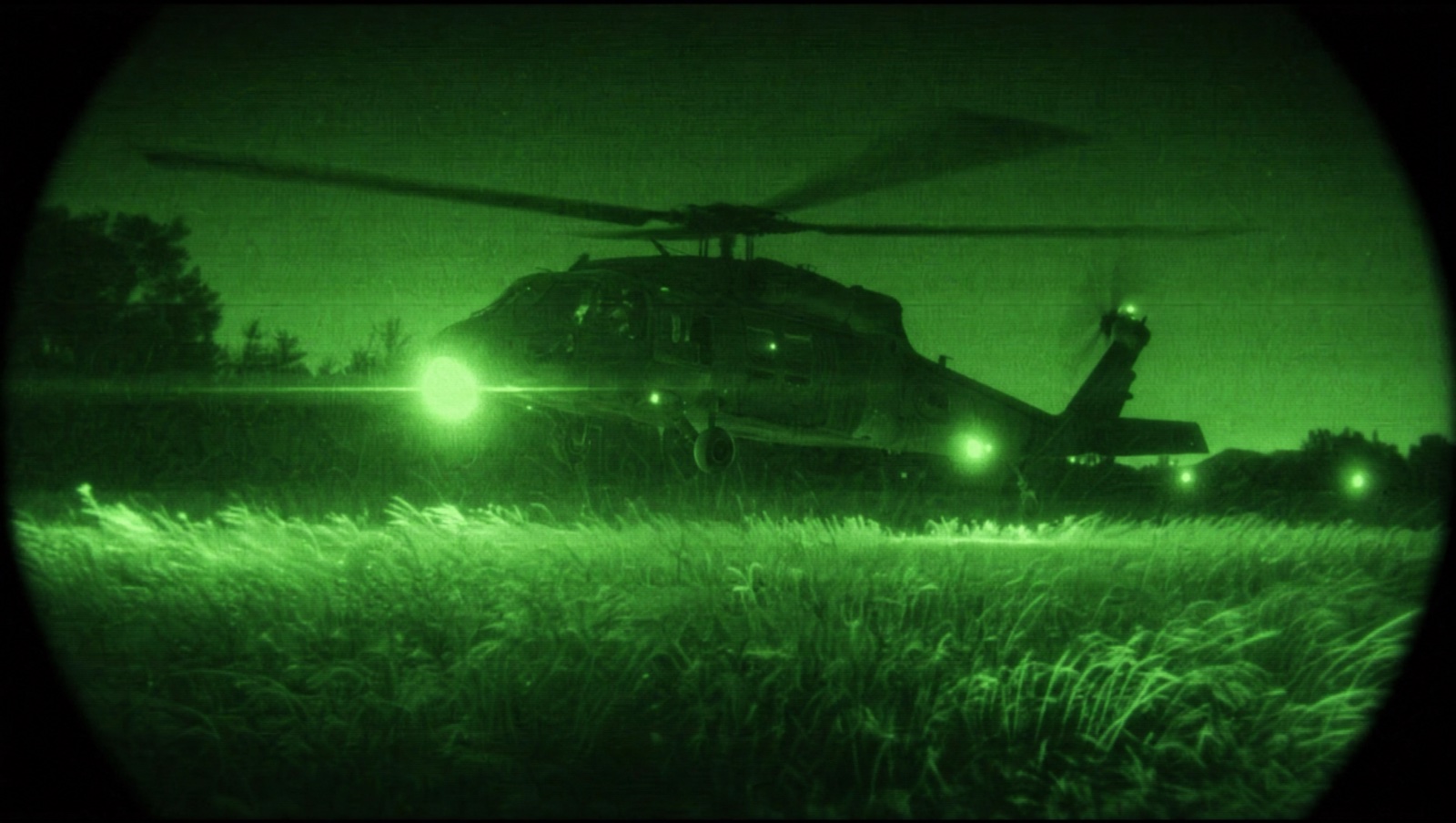
Night Rotors is a fictional documentary archive for Nocturne 47, a rescue crew entering a flooded valley after midnight. The page borrows its structure from an open aircraft door: clipped metal edges, bolts, instrument rails, narrow readouts, and a view that never feels fully safe. The dark state intentionally withholds evidence. Amber shows what an unaided eye can hold; green phosphor reveals the second account—IR strobes, exhaust heat, landing references, and the trace left in grass.
02 / FILM ASSET
One frame, made cinematic.
The production workflow is GPT Image 2 still → Kling 3.0 loop via Higgsfield, with the outputs stored locally under /assets/gen/nightrotors/. The current delivery includes hero.jpg but no loop.mp4, so the hero follows the designed poster fallback: cameraDrift, the moving rotor shadow, restrained flare, letterbox scrims, and the interactive local-IR sightglass create filmic motion without inventing a missing asset. When a local loop is present, it can occupy the same aspect-ratio-safe frame with the still as its poster. Every other visual—the HUD, brownout particles, diagrams, scan field, and grass wash—remains code-generated.
03 / SIGNATURE SYSTEM
The phosphor takeover.
setNVG() in main.js synchronizes both physical switches, their ARIA states, the frame readout, and the browser theme color. It toggles .nvg-on on the root element. That single class changes the complete token system, converts pale paper chapters into black-green displays, regrades the local hero poster, intensifies grain, starts scan noise, and exposes each .nvg-reveal layer.
The transition is staged by .mode-veil: a radial clip-path opens like a phosphor tube blooming to life, then clears before it can obscure reading. The large hero control is repeated as a compact header switch, so the viewer can compare states anywhere on the page without losing position.
04 / VISUAL TECHNIQUES
Motion has a job.
setSightglass()andpositionSightglass()let pointer, touch, and arrow-key users sweep a clipped phosphor aperture across the dark film before lowering the master goggles.runChecklist()begins through IntersectionObserver, verifies seven items in sequence, updates a polite live status, and lands a release stamp.drawDust()caps the brownout canvas at 92 particles. The three phase controls alter drift density and landing geometry while particle color follows vision mode.seedGrass()creates deterministic blade layers for the footer; CSS bends them under a pulsing wash cone. The canvas stops off-screen or in a hidden tab, and reduced motion resolves every system to a still.
05 / PALETTE + TYPE
True night, sharply cut.
TRUE NIGHT
INSTRUMENT
PHOSPHOR
MAP PAPER
Outfit carries titles with dense weight, tight tracking, and compressed leading; its open geometry survives bloom and grain. JetBrains Mono handles times, states, labels, and readbacks. It is deliberately smaller and more widely tracked, creating a procedural rhythm against the oversized documentary voice.
06 / REPRODUCE THIS
Prompt the mechanism.
Describe the transformation before naming components. Give the agent two information states, a physical object that controls them, and a narrative reason the second state matters. Ask for different editorial compositions—not a repeated card grid—and insist that motion explains procedure, atmosphere, or consequence.